
Can Crawl Space Moisture Cause Floors to Sag?
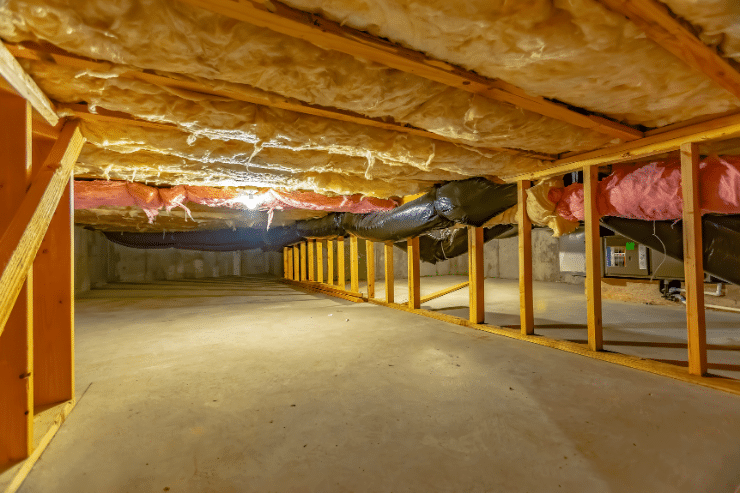
Yes. Crawl space moisture can contribute to sagging floors, especially when the framing beneath the home stays damp for long periods. We see this in Northern Indiana homes where the first floor sits over a crawl space. The homeowner may first notice a low spot, a floor that feels soft, or a room that seems slightly uneven. When we inspect below, we sometimes find that moisture has affected the joists, beams, subfloor, or supports carrying the floor above.
The important point is that the moisture itself is not always the only problem. We want to know what the moisture has done to the structure and whether the floor is still properly supported.
How Crawl Space Moisture Affects the Floor Above
The wood framing in a crawl space is part of the structure of the home. Floor joists, beams, and the subfloor all depend on staying in good enough condition to carry the loads above them. When a crawl space stays damp, that framing can absorb moisture. Over time, wood may soften, deteriorate, or lose some of its strength. High humidity can also create conditions that allow rot or other moisture-related damage to develop.
If the joists or beams weaken enough, the floor above may begin to sag, feel bouncy, or develop low areas. Sometimes the problem is isolated to one section. Other times a larger part of the floor system is affected.
What Does a Moisture-Related Sagging Floor Feel Like?
Homeowners describe these floors in different ways. You may notice:
- A low spot in the middle of a room
- A floor that slopes toward one side
- Softness underfoot
- A bouncy or springy feeling
- Doors that rub or stop latching correctly
- Gaps around trim or interior walls
- Cracks developing in drywall above the affected area
Those symptoms do not automatically mean crawl space moisture is the cause. Settlement, inadequate support, damaged joists, long framing spans, or previous construction changes can create similar sagging floor problems. That is why we inspect underneath the floor instead of diagnosing the problem from the room above.
Standing Water Is Not the Only Moisture Problem
A crawl space does not have to flood for moisture to become an issue. We often find crawl spaces that never have obvious standing water but still stay damp. Moisture can enter from the soil, outside drainage, plumbing leaks, groundwater, or humid air. If that moisture remains trapped beneath the home, the framing can stay wetter than it should.
This is one reason a homeowner may not realize there is a crawl space problem until something changes upstairs. The floor may begin to feel different long before there is visible water inside the living space. A musty smell, damp insulation, condensation, or visible moisture on wood can all be signs that the crawl space environment deserves a closer look.
How Does Moisture Damage Floor Joists?
Floor joists are designed to support the floor across a specific span. When they are in good condition, they transfer that load to beams, foundation walls, or other supports. Moisture can change that.
A joist that stays damp for a long period may begin to deteriorate. In more serious cases, we may find rot, splitting, or sections of wood that no longer feel as solid as the surrounding framing. Once the joist loses strength, it may deflect more under the weight above it.
We also look closely at the ends of joists where they meet beams or foundation walls. Those areas can be especially important because damage near the bearing point can affect how well the entire joist is supported.
Beams and Support Posts Can Be Affected Too
The joists are only one part of the floor system. Many crawl spaces have beams running beneath the joists, with posts or piers supporting those beams. If a beam is damaged by moisture or a support beneath it shifts, the floor above can sag even if the individual joists are still in decent condition.
Moisture can also affect the soil around support locations. If the soil becomes soft or unstable, a post or pier may settle slightly. That drop can transfer upward through the beam and into the floor. This is why we look at the whole support system. The low spot in the floor may be directly above the problem, or the cause may be several feet away.
Can Crawl Space Humidity Cause Problems Without Visible Rot?
Yes. Wood does not have to be visibly rotten before moisture starts affecting the way a floor feels.
Long-term humidity can cause wood to swell, shrink, or move as moisture levels change. The framing may also become more flexible when it stays damp. In a crawl space that already has marginal support or long joist spans, those conditions can make floor movement more noticeable.
We may also find that moisture is affecting several materials at once, including the subfloor, insulation, joists, and beams. The earlier those conditions are corrected, the better chance we have of preventing more damage.
What If the Floor Is Sagging but the Wood Looks Fine?
Then we keep looking. Not every sagging floor over a crawl space is caused by moisture. We may find that the framing is in good condition but the support system below it has settled. The joists may be spanning too far. A beam may be undersized or deflecting. A previous renovation may have changed the way the floor is loaded.
Sometimes the floor has been uneven for decades and is not actively getting worse. That is why the presence of crawl space moisture and a sagging floor at the same house does not automatically prove that one caused the other. We want the evidence to line up.
What We Look For During a Crawl Space Inspection
When a homeowner calls us about sagging floors and a damp crawl space, we look at both problems together.
We may check:
| What We Inspect | What It Can Tell Us |
|---|---|
| Floor joists | Whether they are sagging, damaged, or weakened |
| Main beams | Whether support lines are deflecting |
| Posts and piers | Whether supports have shifted or settled |
| Wood condition | Whether moisture has caused deterioration |
| Subfloor | Whether the floor surface itself has been damaged |
| Crawl space humidity | Whether the space stays damp |
| Standing water | Whether drainage is part of the problem |
| Plumbing | Whether a leak is contributing |
| Ground conditions | Whether moisture is coming from below |
| Previous repairs | Whether the floor has already been modified or supported |
We also ask when the homeowner first noticed the sagging and whether the condition seems to be getting worse. That history can help us separate an old floor slope from a problem that is still developing.
Should You Fix the Moisture or the Sagging Floor First?
If moisture is actively contributing to the damage, we usually need to think about both. Repairing weakened framing without addressing the damp crawl space can leave the new or reinforced wood exposed to the same conditions. On the other hand, drying out the crawl space will not automatically lift a floor that has already sagged or repair damaged joists.
The right sequence depends on what we find. In some homes, the crawl space needs drainage, moisture control, or encapsulation along with structural floor repairs. In others, the moisture issue is minor and the sagging is mainly related to supports or framing. We want the repair plan to address the cause and the damage, not just one or the other.
Will Crawl Space Encapsulation Fix a Sagging Floor?
Not by itself. Encapsulation can help control moisture in the crawl space, but it does not rebuild a damaged joist or raise a sagging beam.
If the framing has already weakened or the support system has moved, structural repairs may still be needed. That could include joist repair, beam support, floor stabilizers, or another method depending on the condition.
The value of moisture control is that it helps improve the environment around the repaired structure and reduces the chance that the same moisture conditions continue.
Can a Sagging Floor Be Raised Back Up?
Sometimes. The amount of correction depends on how much the floor has moved, how long it has been in that position, and what is happening in the framing.
In some cases, we can improve the elevation while adding proper support. In others, the safer goal is stabilization rather than trying to return an older floor to perfectly level.
We also have to think about what is above the floor. Drywall, cabinets, tile, plumbing, doors, and other finishes may have adjusted to the current position of the structure. Moving the floor too much or too quickly can create damage elsewhere. That is why we do not treat floor leveling as a simple matter of pushing the low spot upward.
When Should You Have the Crawl Space Looked At?
If you have a sagging, soft, or bouncy floor and you know the crawl space stays damp, it is worth having the area inspected. We pay closer attention when there are several symptoms together, including:
- A floor that is becoming more uneven
- Musty odors in the home
- Standing water in the crawl space
- Visible wood damage
- Soft or weakened joists
- Doors that have recently stopped closing correctly
- New drywall cracks
- Support posts that look tilted or displaced
The sooner we understand what is happening, the easier it is to decide whether the problem is moisture, framing, supports, or a combination of all three.
We Look at the Structure and the Moisture Together
A sagging floor over a crawl space is rarely something we want to treat as a flooring problem alone.
At A&M Waterproofing & Foundation Repair, we look at the joists, beams, supports, crawl space moisture, drainage, and other conditions beneath the home before recommending a repair. If moisture is contributing to the sagging, we want to address that along with the structural problem. If the framing issue has another cause, we want to identify that too.
If your floors feel soft, uneven, or lower than they used to and you have a damp crawl space, contact our team for an inspection. We serve homeowners throughout South Bend, Mishawaka, Elkhart, Plymouth, and surrounding Northern Indiana communities, and we can help determine what is happening beneath the floor and what it will take to correct it.