
What Happens When an Interior Drainage System Stops Working?
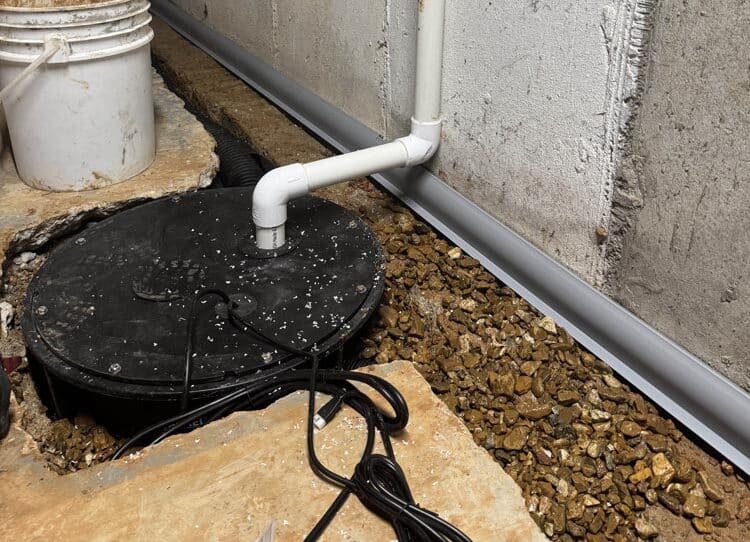
If an interior drainage system kept your basement dry for years and water suddenly starts showing up again, it does not automatically mean the entire waterproofing system has failed. A basement drainage system depends on several parts working together, and a problem with one part can make the whole system look like it stopped doing its job.
When we inspect a basement in this situation, we start with the water path. The system has to collect groundwater, move it toward the sump basin, pump it out, and discharge it far enough away that the same water is not coming right back toward the foundation. If any part of that process changes, the basement can start leaking again.
That is why we do not begin by assuming the old system needs to be torn out. We first look at how the basement is getting wet now, how the sump is behaving, what happens during heavy rain, and whether the water is even reaching the drainage system in the first place. That same diagnosis-first approach is what we use when deciding what a basement actually needs before recommending waterproofing.
An Interior Drainage System Is More Than the Pipe Under the Floor
Homeowners often think of interior drain tile as one continuous system, but there are really several jobs happening. Water has to reach the perimeter drainage, the drainage has to move that water toward the sump, the pump has to remove it, and the discharge line has to carry it away from the house.
A problem at any one of those points can create a wet basement. A sump pump can be running correctly while the drainage system is not getting water to the basin. The drain can be open while the pump or float is failing, and a perfectly good pump can still create problems if the discharge is blocked or sending water back toward the foundation.
That is also why simply replacing the sump pump does not always solve a recurring leak. We look at the entire basement waterproofing system rather than one component by itself. A&M’s current systems are designed around collecting water, moving it toward the sump, and removing it from the home, so all of those stages matter when we troubleshoot an older installation.
The Way the Basement Starts Leaking Again Gives Us Clues
The pattern of the new leak usually tells us where to look first. Water returning along the wall-floor joint can make us question whether the perimeter drainage is collecting water the way it used to. If the sump basin is nearly dry while water is appearing somewhere else in the basement, we start considering whether the leak is bypassing the drainage system altogether.
A pump that suddenly runs much more often gives us a different set of questions. The home may be seeing more groundwater than usual, the pump may be struggling, the discharge may be restricted, or water may be cycling back toward the house after it is pumped out. The pump activity is useful information, but it still does not tell the whole story by itself.
We also pay attention to whether the problem only happens during the biggest storms. Northern Indiana can go through long wet periods, saturated soil, spring snowmelt, and freezing conditions that expose weaknesses an older system may handle without trouble during ordinary weather. If the basement stays dry during moderate rain but leaks during prolonged storms, that points us toward capacity, drainage coverage, discharge performance, and how much water is reaching the foundation at one time.
A new wet area matters too. If one section of the basement was always the problem but water now appears somewhere completely different, the original system may still be doing its job in one area while another water path has developed or was never included in the original scope.
What We Check Before We Blame the Drain Tile
Interior drainage can develop restrictions or damage, but the pipe is only one possible source of failure. Depending on the system, sediment or mineral buildup can reduce how freely water moves, and older or partial installations may not manage every section of the basement equally well. The condition and design of the existing system have to be inspected before we know whether the drainage itself is the problem.
The sump side deserves the same attention. We look at whether water is actually reaching the basin, whether the pump activates when it should, how the float is operating, and whether the pump appears to be keeping up with the amount of water entering. A sump pump
is only useful if the collection system gets water to it and the discharge can carry that water away. A&M’s own recent content makes the same point: homeowners often blame the pump when the real issue is somewhere else in the drainage path.
The discharge line is another place we look closely. A restriction, poor outlet condition, or water discharging too close to the house can allow water to remain near the foundation or return to the same soil the system is trying to drain. In colder weather, the outside portion of the discharge can also become more important because freezing conditions can affect how freely water leaves the system.
We also look for water that the interior drainage was never designed to collect. A leaking wall crack, basement window, plumbing penetration, or water entering higher on a wall may show up on the floor and make it look like the drain tile failed. If the water never reaches the collection plane, an open drainage line and a working sump pump cannot solve that particular leak.
A Working Sump Pump Does Not Prove the Whole System Is Working
This is one of the most useful distinctions for homeowners to understand. You can hear the sump pump running and still have a waterproofing problem somewhere else.
If groundwater is reaching the drain tile and the pump is removing some of it, the sump may be doing exactly what it should. But if another portion of the basement is outside the drainage coverage, or if water is entering through a crack or window above the system, the basement can still get wet.
The opposite is useful too. If water is appearing at the wall-floor joint while the sump basin remains dry, that tells us the water may not be making it to the basin. That could point us toward the collection side of the system, an incomplete drainage run, or a different entry path altogether.
We want those symptoms to agree with what we find during the inspection. That is more useful than replacing one part simply because it is the easiest part to see.
When a Smaller Repair May Be Enough
An existing waterproofing system does not always need to be replaced from end to end. If the inspection shows that most of the system is still doing its job, the problem may be limited to a pump, discharge issue, localized drainage problem, or another repair outside the main drain tile.
That is consistent with the way we approach basement water problems in general. We have written before about waterproofing repairs that did not require a full system, because not every leak deserves the largest possible scope. Sometimes a failed sump component, drainage problem outside the home, wall crack, or another localized condition explains why the basement became wet again.
The age of the system alone does not make that decision for us. What matters is whether the existing drainage still collects and conveys water effectively, whether the sump and discharge can handle it, and whether the current leak is actually connected to that system.
If the evidence supports a targeted repair, we would rather correct the part that is failing than assume everything has to be replaced.
When Replacement or Expansion Makes More Sense
There are also situations where a larger correction is the better answer. An older system may be incomplete, poorly configured, damaged, inaccessible, or simply not cover the areas that are now taking on water. If the basement is leaking in several places and the inspection shows the existing drainage cannot reliably collect or move that water, repairing one component may not solve the larger problem.
The same is true when the original system only addressed part of the perimeter and the water problem has become more widespread. Chasing one wet spot at a time can become expensive if the underlying issue is that groundwater is affecting a much larger part of the foundation.
We still want the recommendation to follow the evidence. A bigger repair should be based on what the system can and cannot do, not simply on the fact that the basement is wet again.
This is where the history of the house helps us. We ask how long the system worked, when the leak returned, whether the wet area moved, how the sump changed, what happens during different kinds of storms, and whether previous repairs were made along the same section. Those details help us decide whether the system needs one correction or whether the overall design no longer matches the water problem.
What We Want to Know Before Recommending the Next Repair
When we inspect an interior drainage system that appears to have stopped working, we are trying to answer a few practical questions. Is the water reaching the drainage system? Is the drainage moving it to the sump? Is the sump removing it reliably? Is the discharge carrying it away, and is the leak actually coming from somewhere the system was designed to manage?
That sequence keeps us from treating the visible water as the diagnosis. It also helps us avoid replacing a drainage system when the actual issue is a sump, discharge line, wall crack, window, grading problem, or another source outside the system.
If your basement was dry for years and has started leaking again, we can inspect the existing system before assuming you need to start over. At A&M Waterproofing & Foundation Repair, we look at the drainage, sump, discharge, foundation, and exterior water conditions together so the next repair matches the part of the system that is actually failing.
For homeowners throughout South Bend, Mishawaka, Elkhart, Plymouth, and the surrounding Northern Indiana communities, that may mean a smaller correction. In other homes, the existing system may need to be expanded or replaced. The important part is figuring out which situation you are in before making that decision.